Total Pageviews

Saturday, May 21, 2011

Aftermarket hubs for BMW plunger frame bikes.

In the 50's and 60's there were several companies in Germany and the US providing aftermarket parts for BMW motorcycles.  Notables from Germany include the firms of Ernst Hoske and Georg "Schorsch" Meier.  Both turned their passion for racing into business ventures.

One of the parts offered by both Hoske and Meier were aftermarket hubs.  As the plunger frame bikes up to 1954 utilized a 200mm half hub design, the width of the brakes on the stock machines was quite small.

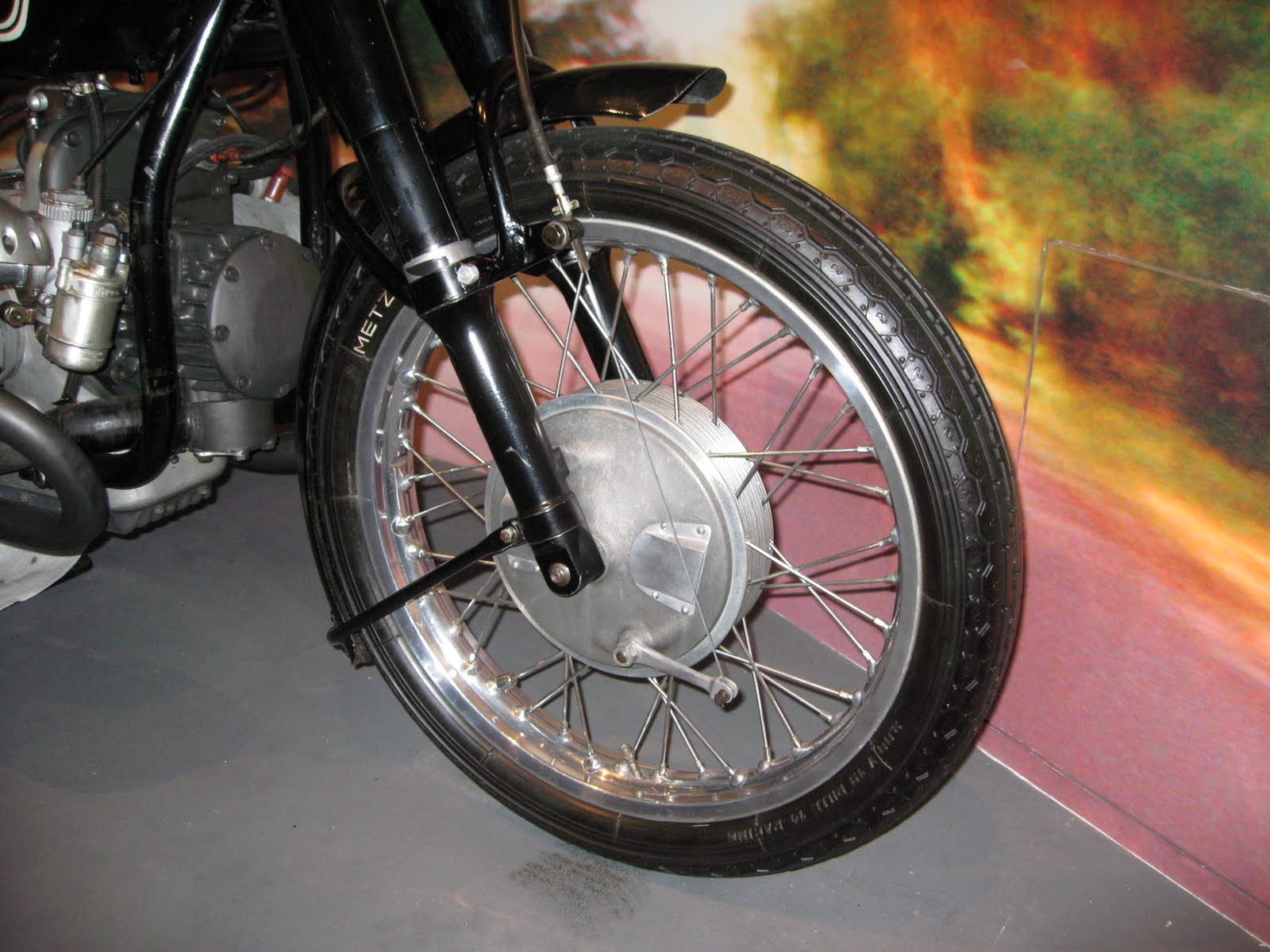
Hoske offered a replacement full width aluminum hub.  Unlike the factory hubs which were fitted with drive splines front and rear, the Hoske front hub deleted the drive spline to save weight. 

The Meier hubs are also full width and made of aluminum.  The front and rear hubs are identical with a drive spline in both.

Hoske also made lightweight versions out of Elektron (a magnesium alloy).  However when found today, these are often very corroded or have cracks in them. 


Complete wheel with 19" high lip Weinmann rims, and half polished Meier hub.  Note the center is the same rough cast finish as the motor, trans and final drive.


Notice from the Meier Prospekt that the hubs were offered in three varieties, matte finish, partly polished or polished. 


Here is an example of the Meier full width hub in full polished form.

 Below is a photo (albeit not a great one) of the Hoske firms Prospekt for racing parts.  I have shown the page describing the available wheels, hubs, brakes, etc.


Here is a front hub and brake setup. This is a dedicated front hub as you'll note there is no drive spline.  Pictured is a standard simplex front brake plate.  The shoes are wider than standard.


Hoske rear hub.


Same hub as above from the outside.  I have seen two variations of this hub.  Some have the bolts going all the way through with cap nuts on the outside.  I have also seen variations where the bolts don't go all the way through, thus from the outside, the front and rear hubs look the same. 

You will notice that the Meier hubs use a bent spoke, while the Hoske hubs use a straight pull spoke.  Both the Meier and Hoske hubs are equally desirable. 

Monday, May 2, 2011

Schorsch Meier R51/2

Here is a project I am currently working on.  The posted pics are of the bike at the time I purchased it a few years ago.  Its an interesting bike, one that I like to refer to as a gentleman racer.  Obviously not a works machine, it started life as a civilian model, but then had some nice, and interesting upgrades added.  It looks to me as though someone went through the Schorsch Meier catalogue and bought nearly one of everything and put it on the bike.  It has high compression pistons.  The final drive gearing is standard.  I haven't yet torn open the gearbox, though I suspect it may be standard as well. 

For now I will post pictures of the bike as I found it.  I will later add some photos of the restoration that is underway.  Comments welcomed and encouraged. 


Schorsch Meier full width aluminum hubs front and rear.  Schorsch Meier racing fender.  Faltenbalge in place of metal front shock covers.  Rare Schorsch Meier/Lugauer racing gas tank.

Patina!

Note the matching front and rear hubs.  These came with either a rough cast center section or full polished.  These have the rough case centers which look nice, and match the engine and transmission cases.  The keen eye will spot the Magura Rennhebel (racing levers).  Don't think I'll be keeping the high bars!

Rare 19 inch high lip Weinmann rims.  I've never seen another pair of high lip in the 19 inch diameter.  Obviously wrong valve covers.  I'm looking for original ones in good shape if anyone has any.


More patina.


Grease is a great preservative.  I am thankful that people don't clean old bikes before they let them sit for years.

I am part way through this restoration.  The wheels are rebuilt.  The bike is completely broken down.  Next step is to have the frame and forks painted, and then I can put a rolling chassis back together. 

Unfortunately I only know the history back about 30 years.  It was owned by Rick Monahan of Black Kat in Venice Beach, CA from the early 80's until around 2001 or so.  Before the 80's not much is known.  I do not know if it was raced or was simply a sporty daily rider.

PROGRESS:

Progress on the restoration is slow, but proceeding.  The frame and fork parts are now in primer.  The Meier front fender has been straightened and primed. 

The front fender is a little bit different than the stock.  For starters it is not valanced, and is considerably lighter.  It is much more like an R68 fender than an R51/2 fender.  Furthermore it is attached to the fender stays by chrome clips which are bolted to the fender.  Of course when I got it one of the clips was missing and the others were bent or rusted. 

A tool and die maker friend made up a die and we made new clips. 

Saturday, April 23, 2011

BMW Kompressor

Not too much commentary for these bikes.  Enough has been written in various publications about the history of the bikes, and their triumphs before the war when the use of the Kompressor was still sanctioned.  Here are some assorted pics of various BMW kompressor machines with close-up detail you can't find in the books.  The first bike is in the BMW Museum in Munich.

Aluminum bars. Split fuel tank with left and right sides that bolt together in the middle. R. Muhle tachometer.
 

As is commonly known, the so-called plunger frame bikes have no true dampening at the rear.  There is only a spring on the left and right.  As such, many works bikes incorporated a friction dampener to the rear to try to combat some of the bounce.  Hidden in this photo behind the rear spring is a metal post that runs from the rear axle to the rear arm of the scissor dampener which you can see mounted to the rear frame tube.  Just like the steering dampeners, one can increase or decrease the amount of friction by tightening or loosening the knob.  The same round friction disks were used for the steering and the rear suspension. (The vertical metal post and tube attached to the axle in this picture are for suspending the bike as part of the display at the BMW Museum.)
Notice on the rim the four dots.  These are rivets where the rim was seamed together.  This is a steel wheel.  The R51RS used a similar seam and rivet design, although in aluminum.


Notice the removeable frame reinforcing tubes on the side of the frame.  Attached obviously with bolts as there removal is required to pull the transmission or motor. The rear set of pegs is obviously not for a passenger!


Single Amal Fischer carburetor feeding the kompressor.


Sprung drilastic saddle.  Partial view of "rennbrotchen". 


Accomodation for spare plugs, including wrench.  Actually the plugs weren't spares.  They used one heat range for warm up and another for the race.  This backfired, no pun intended, at one important venue when the threads in the heads were stripped while attempting to swap the plugs right before a race. Bosch FJ2 type magneto.  Note that the crank case, and transmission are made of Elektron, a light magnesium alloy.


"Lightened" brake pedal and hand shift lever.
 This next bike is in the collection of the Zweirad Museum in Neckarsulm, Germany.  It's a bit of an amalgamation of parts, some things were changed over the years, such that its not all period correct.  Still, any BMW collector would love to have it, including me! These practically never change hands.


Nice view of the "Koenigswelle" or King Shaft that drives the overhead cams via bevel gear.  Amazing that this is 1930's technology.  It was reintroduced in the 1950's with the RS54 and its precursors.  And the design was recently used again with the latest generation of DOHC motors used on the HP2 Sport and subsequently the R1200GS.


The third bike is one that was, for a time, here in the US.  It was sold a couple of years ago to a wealthy collector in Germany.  The last time I saw it, it was in a thousand pieces being reverse engineered to make a small series of replicas. 


The fourth bike needs no introduction, the ex-Meier, ex-Surtees 1939 TT winning kompressor in the collection of BMW in Munich.


Garage Art


I don't mean to deviate too far from the theme of my blog, which is historic BMW sport and race bikes, but I thought this bike was interesting enough to warrant inclusion. 

The pre-war BMW aficionado will note the horizontally opposed twin engine in the fore-aft configuration with a large exposed flywheel.  The motor is an M2B15 BMW fitted to a Victoria KR1.  Those familiar with the history of BMW know that BMW supplied motorcycle engines to independent motorcycle manufacturers before deciding to make a bike of their own construction in 1923, namely the R32.  As such, BMW motors can be found in early 1920's bikes such as the Victoria,  Helios, Flink and Bison.
 
This bike was unearthed a few years ago by a farmers plow.  The original owner had buried the bike before he went off to fight in WWII.  Alas, he never returned and the bike was entombed for the next 60 years before being unceremoniously discovered.  It now resides in the private museum collection of Franz Amering in Vorchdorf, Austria.

Obviously not a candidate for restoration, it is a great conversation piece with an interesting history.

Those who find themselves on the A1 autobahn in Austria should stop in to Franz's museum.  It is arguably one of the best, and most complete museums of BMW motorcycles in the world. 

Motorradmuseum Vorchdorf

In a future post I will show some high-lights of Franz's collection.

Tuesday, April 12, 2011

ISDT

The International Six Days Trial (ISDT) is the oldest 'off road' motorcycle event on the FIM Calendar.

The ISDT was first held in 1913 at Carlisle, England. The event has occurred annually since then, apart from interruptions due to World War I and World War II, at various locations throughout the world. The ISDT is a true test of machine, rider, skill, and reliability.   


Up until 1973 the contest was always held in Europe. In 1973 the event travelled to the United States for its first non-European venue.  Since then the race has been outside of Europe more frequently: twice in Australia (1992 and 1998), once more in the USA (1994), Brazil (2003), New Zealand in 2006 and Chile in 2007.  In 1980 the name was changed to  'International Six Days Enduro' (ISDE).

The event has attracted national teams from as many as 32 different countries in recent years. Over its long history the rules and conditions have changed to keep in step with the developments in the sport, but it remains a supreme test of rider and machine. Over the six days and upwards of 1250 miles a rider must contend with strict rules about time allowances and restrictions on mechanical replacements, as well as carrying out his or her own track-side repairs.

Usually referred to as the 'Olympics of Motorcycling' with trophies for best six-rider national, four-rider junior national, three-rider women's national, three-rider club and three-rider manufacturing teams. Gold, silver and bronze medals are awarded on an individual level.

The medals are typically awarded based on percentage of finishers, or relative to the best individual performance in the event within one of the three displacement classes.

The ISDE can attract entries of more than 500 riders, together with thousands of support crew and spectators. This has a major impact on tourist income for the venue in which it is based each year.


For a list of host, venue and winners of the ISDT from 1949 through 1980, click here: ISDT


Herbert Schek, Gold Medal winner on board a BMW (great jersey!)

BMW involvement in the ISDT dates back to the infancy of the marque as an independent motorcycle manufacturer. 

Below is an example of a BMW works prepared R67 ISDT.  This particular bike, reportedly raced by Georg "Schorsch" Meier, was previously in the collection of Willy Neutkens.  Neutkens was a long time BMW dealer and collector in the Netherlands.  After his recent passing, the family put his collection up for auction, which was held in Munich, in conjunction with BMW Classic.

The bike was purchased by BMW for their collection, and now resides in the BMW Museum across from street from the BMW Welt complex. 


Notice the front number plate is on a pivot.  This serves two purposes, the plastic plate protects the glass of the front headlight during the day, and can be flipped up for riding at night.


Two into one exhaust is for more than just good looks.  The higher location on the bike affords one the capability of crossing water hazards without filling the tailpipes!  What looks to be a second carburetor on the right side is a spare slide attached to the spare throttle cable.  In the event of a slide or cable failure, the pilot could easily swap. 

Knobby tires front and rear.  Also notice that a bar is welded to the front and rear axles to afford quick wheel removal in the event of a flat.

Nice closeup of the Magura quick throttle and Magura racing levers or "rennhebel".  Also note the spare cables strapped the throttle cables in the event a trail side repair is necessary.


Detail of the "crash bars" and the oil pan guard.

Rennbrotchen or "racing bread loaf".  Note this one differs from the road racing version as a side zipper allows one to stash tools and spares.


Cross drilling the seat frame must have saved at least a few grams of weight!


Notice the rare fender with a subtle flare at the bottom which is a hybrid design between the R68 version and the larger flared street version found on the civilian R67.

Compare and contrast the differences from the mid 50's version of a works BMW ISDT racer with the 1980 ISDT winner pictured below. 


See below for some pictures of an R68 ISDT replica in a private collection here in the US.  Luckily for those interested in recreating one of these off-road machines, many of the parts such as the special rear fender, 2 into 1 exhaust, oil pan guard, etc are available, albeit at a hefty price.


Hoske ventilated front "bremseplatte" and Hoske full width "nabe".  Both very rare and very expensive.  The keen observer will also note the deep sump on this particular bike.  

With the 2 into 1 exhaust crossing above the right side cylinder and head, one must use a special clip to keep from melting the right side throttle cable and fuel line!

Hoske full width rear hub.  The front and rear hubs are different.  Unlike most BMW hubs which are interchangeable front and rear, the front Hoske hub has no drive spines, to save weight. The shoes and pads are of couse wider, providing extra stopping power.