Total Pageviews

Sunday, June 17, 2012

Concorso d'Eleganza Villa d'Este


Concorso d'Eleganza Villa d'Este


Since 1929 the Villa d'Este in Cernobbio, Italy, on the banks of "Lago di Como" has played host to the Concorso d'Eleganza.  As has been the case with several other high profile automotive events, the Concorso has recently added motorcycles to the venue.  2012 was the second year that motorcycles have been shown and displayed in tandem with the cars.

This years event, held Friday May 25th through Sunday May 27th, was a smashing success.  The Concorso's main sponsor is BMW, and they spared no expense to make sure that the event was top notch.


View of the dock at Cernobbio exiting from the water taxi.
The Concorso is actually two events at two venues, combined in to one.  The Villa d'Este is a very exclusive and historic hotel at the waters edge.  While able to accomodate the fleet of very expensive and historically important cars that are invited each year, along with their owners, the venue lacks the size to allow the general public to participate at the hotel.  Therefore a private showing and judging of the cars is held at the Villa d'Este on Saturday.  Then early Sunday morning, the cars a brought the few hundred meters through the quaint town of Cernobbio to join the motorcycles for display at the Villa Erba.


Villa Erba as viewed from Lago di Como.
 The motorcycle exhibition takes place throughout the weekend at Villa Erba.  BMW, primary sponsors of the Concorso, erected an elaborate stage for the bikes on the grounds of the Villa.  The impressive structure consisted of a steel frame with wooden floor and stretched canvas ceiling.  A tremendous amount of time, energy and money went in to erecting the structure which is only used for the one weekend!  Needless to say, an army of workers from BMW is required to set up and remove not only the infrastructure, but the motorcycles themselves.


The special motorcycle exhibition erected by BMW for the event at Villa Erba.

Inside the exhibition hall on the grounds of the Villa Erba was a special exhibition of BMW racing cars and motorcycles.  The bikes on display included an RS54 Rennsport Gespann, Butler and Smith R90S, R5SS and landspeed record winning Kompressor.  Less vintage, though still interesting, was the Marco Melandri S1000RR world superbike and the BMW Italia Goldbet S1000RR. 


R5SS

R90S Butler and Smith Superbike

RS54 Short Stroke Sidecar


1937 500cc 100hp World Record Machine piloted by Ernst Henne

Marco Melandri S1000RR World Superbike


BMW Italia S1000RR
The motorcycle exhibition of invited machines was held outdoors in a beautiful pavillion.  In true BMW style, everything was professionally laid out.  The bikes were all represented by plaques indicating the make and model.  In typical German fashion, representatives from BMW Classic spaced out the motorcycles using a tape measure!  A red velvet rope kept curious onlookers from getting too close to these exceptional machines.  (This was especially important as the  MV Agusta in the concepts and prototypes category was a lifesize clay rendering.)

Accompanying the show was a wonderfully illustrated hard cover book outlining the themes of the various classes as envisioned by motorcycle enthusiast and author Stefan Knittel.


As my interest is in BMW motorcycles, I spent considerable time pouring over the details of the 1939 Kompressor that was on display. 


Sebastian Gutsch from the BMW Classic team stands by in his togs as he gets ready to ride the Kompressor from Villa Erba to Villa d'Este.


And now for a special treat.  The sound of a BMW prewar Kompressor.........


Sunday, February 5, 2012

BMW Earles Fork Performance Parts

As has been documented and discussed elsewhere, there was a short hiatus after the war before BMW was allowed to produce motorcycles once again.  Indeed the first post-war twin didn't appear until the 1950 twin cam R51/2 was introduced.  It was, in essence, a slightly modified version of the prewar bike of similar name.   While a sporting bike, it wasn't a "sport bike".  And a short two years later, the larger displacement R68 became the crown jewel of the BMW civilian line up, and the twin cam motor was unceremoniously dropped.

With its 26 mm carbs, magneto ignition and higher compression pistons, the R68 didn't disappoint.  After its 3 year tenure, the motor platform was transitioned to the R69.  In essence, the motor saw little change, but of course the frame was radically different.  The rear of the bike gained a true oil dampened suspension, in place of just springs.  And the Earles Fork was transitioned from the RS54 racebike, to the civilian model. 

As owners of any Earles fork model know, the geometry of the front end was meant to counter act the normal dive sensation one feels when applying the front brake to a more traditionally forked bike.  In fact the front end on an Earles equipped bike rises slightly.  The overall geometry of the bike and front end was the reason the bike was so popular with the "seitenwagen" crowd. 

Now of course when you think of 60's performance bikes, perhaps BMW isn't the first to come time mind.  Nortons, Triumphs and Ducatis often lead the way in this regard, however there were plenty of "weekend warriors" looking to get extra performance from there Bavarian machines.  Enter the after market suppliers.

While there were a host of offerings available to make your bike look cool, or to make it more comfortable for a long trip, there were also companies offering aftermarket performance parts with the promise of more speed.

Once such company was Bowman.  They supplied cast aluminum deep sump oil pans, adding extra oil capacity and the promise of cooler oil.  (A side benefit was that unlike the stock sheet metal pans, they weren't prone to warping and hence leaking when overtightened.).  In addition, Bowman offered an aluminum flywheel.  By decreasing the rotating mass of the motor, shifting was smoother, and less clunky.  And arguably the engine revved up faster.  Bowman also supplied pistons and rings. 

Early on the 1950's the firm of Ernst Hoske supplied all manner of performance parts.  In fact in one of their early catalogues they offered a kit, by which a handy owner could transform any pre or postwar R51 twin cam bike into an R51RS replica by swapping out the timing chain for gears, and replacing the front engine cover with a total loss version.  Of course the battery coil ignition was dropped in favor of a magneto.  The kit included new cams, valves and valve springs.  With the addition of a tach drive, and tachometer, the average Joe could be off to the weekend races!  Of course this transformation wouldn't be complete without some Hoske full width racing hubs, and a sportier tank.  A full transformation would necessitate swapping out the transmission gear cluster or a more sporting version as well.

As time went on, Hoske, himself an ex-racer seemed to concentrate more efforts on after market fuel tanks, and less on true sport or racing parts.  In fact his catalogue from 1965 offers six different gas tanks.  Also on offer was a crank driven tachometer, an aluminum extension for the oil pan to add capacity, and an oil temperature gauge.  Also offered were Renntütenform mufflers, clubman or clip on handlebars, and a sport front fender.  Arguably, few of the above parts offered a true speed advantage.  Still for sale, however,  were sport cams, and larger valves, by which one could hope to squeak out perhaps a couple extra horsepower. 

The third name that comes to mind is the firm of Schorsch Meier.  With a win in the senior TT at the Isle of Mann in 1939, Meiers legacy was cast.  He parlayed his fame into a successful post war motorcycle and car dealership.  In fact some of his parts, such as the 6.5 gallon sport tank, and the bench seat were adopted by BMW and included as factory options when ordering a new motorcycle from Munich in the late fifties and sixties.

For further discussion of 1950's sport parts offered by Meier, see this prior post.

It seems today, little has changed.  While some guys are perfectly happy with a stock version Slash2, still others yearn to deck their bikes with performance bits and modifications, and are willing to pay for the privelege of doing so.  Large Hoske tanks still command a premium, and the 6.5 gallon Meier sport tanks are almost always preferred over the smaller 4 gallon versions. 

Saturday, December 17, 2011

Rennsport

Some time ago I shared a number of photos of BMW Works kompressor bikes.  These are mostly in museums, with a handful in private collections.  I thought I would also share some pictures of Rennsports or RS54's.

In 1953, BMW introduced a low number production race bike.  It was intended for serious privateer racers.  The machine ultimately produced was the evolution of a series of engines based on the overhead cam design. This design exercise began in the late 40's, and arose from the need to find a replacement for the aging pre-war kompressor motors, which ceased to be as effective when the FIM banned supercharging after the war.  For a nice description, reference the book "BMW Engines" by Dr. Karlheinz Lange.

The original production of RS54's consisted of approximately 25 bikes.  These were long stroke machines, having a bore of 66 mm and a stroke of 72 mm.  The bikes were originally equipped with a 4 speed gear box. 

Later developments lead to production of a short stroke machine with a bore of 70 mm and a stroke of 66 mm.  The shorter stroke motor revved higher and provided more horsepower.  The short stroke motor was initially used on the works bikes, but was successfully utilized later by quite a number of sidecar racers who took home a long string of championships in the 60's and 70's.


Here is an early photo of a pre-production or works model.  Several differences are evident when compared to the bike that was ultimately produced as what we now refer to as the RS54.  This particular bike is colloquially known as the "Zweibolzen".  Note that there are "two bolts" fixing the valve covers to the heads.  The later RS54 utilitzed four bolts.  The motor is actually quite different in form.  Also note the telescopic forks fitted here.  Ultimately, a decision was made to utilize the Earles fork on the production RS54.  A year later the Earles fork also showed up on the newly redesigned sport and touring models, the R50, R60 and R69.


Above pictured is a restored Zweibolzen from the collection of Franz Amering in Austria.  Photos from MVCA.at.   The frame pictured here appears to be a modified plunger frame.  As we will see shortly, the production RS54 utilized a totally new frame design with a rear swingarm that enclosed the driveshaft.  However, unlike later civilian models, the rear swing arm of the RS54 does not contain oil. 


Period photo of Zweibolzen Type 253 motor. Copyright Wil Elbers.
The Zweibolzen motor was further developed and refined, ultimately into the production RS54 of which somewhere around 25 were built originally. 

Perhaps one of the most original appearing bikes in existence today belongs to BMW and is housed at the BMW Classic building on BMW Allee just off Schleissheimerstrasse in Munich.  I had seen and photographed the bike there on a prior occasion.  I saw the bike again at the Saisonstart Open House at Niederlassung BMW.  Its a nice event they throw each year to kick off the riding season in March.

I do not know if this bike is one of the original 25 or not.  I suspect it isn't, but rather a very fine bike produced later but to original 1954 trim. This particular bike has a four speed gearbox.  The original long stroke bikes were equipped with a four speed gearbox, while later short stroke bikes are usually seen with a five speed gear box attached.

It is difficult to tell outwardly whether it is a long stroke, or short stroke motor.  I'm sure someone more knowledgeable than me might be able to tell. 


The tank is of beautiful form and held in place by a long metal strap running fore and aft, under which is a rubber strip which protects the paint from the metal.


Wonderful little VDO tachometer.  Many RS machines seen today have a Smiths ATRC tachometer mounted.  Perhaps they were more accurate or reliable.


The tachometer drive comes in two forms.  The solo machines most often utilized the a tach drive from the breather, while sidecar machines often drove the tach from the crank nose.


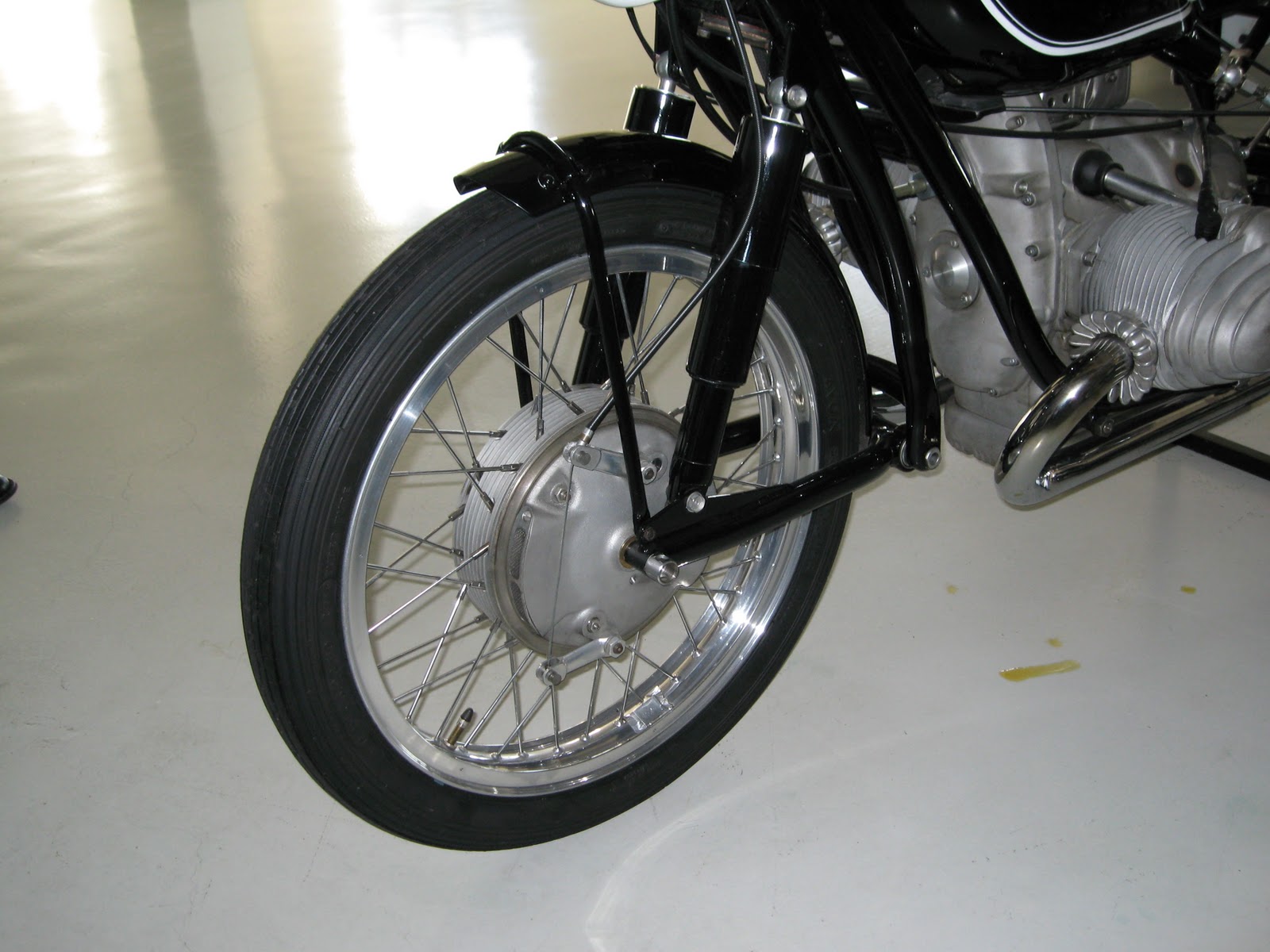
Earles fork front end.  2LS front brake.  Notice the spoke nipples are at the hub side, while the spoke head is at the rim side.  A unique feature not found on other BMW of the same period.


The carburetors are 30 mm Amal Fischer. 


Nice photo of aluminum tube housing the bevel shaft which drives the overhead cams.

Saturday, October 15, 2011

Going on a diet

The motorcycle racers of today have at their disposal a host of exotic materials by which to make parts lighter, and even stronger as compared to the past.  Titanium bits and pieces are ubiquitous in todays paddock. 
Carbon fiber has revolutionized motorsport, and has even found its way into production bikes.  (ie the HP2 Sport). 

Guys racing before such exotic materials were available resorted to more practical solutions for decreasing the weight of a bike.

Of course a race bike would not have the routine road going accoutrements such as lights, horn, signals, etc.  Casting material for many bikes differed from the pedestrian models as well.  Elektron, a magnesium alloy, was used extensively on works bikes and even by privateer racers before and after the war. 

Any part on a bike that could be lightened, while maintaining its integrity, was subject to a diet.  For sheet metal parts, this often meant drilling holes to reduce the amount of material.  Simple things like changing a steel drain plug to an aluminum one, would amount to a small reduction in weight.   But when multiplied by the number of plugs on the bike, could add up to real savings at weigh in.


Pictured above are two drain/fill plugs. They are M14 x 1.5.  The plug on the right is a standard issue item found on most pre 1969 BMW motorcycles.  It is SW 19 (SW = schlüsselweite = width across flats, or wrench size).  Material is steel, cadmium plated.

On the left is a "lightened" racing version.  While still the same thread diameter and pitch, the length is slightly shorter, and it is SW 14.  The material is aluminum.  

The steel plug weighs in at 29.3 grams, while the aluminum plug weighs 6.8 grams.  (A 77% reduction in weight.)  If you multiply by 5 (the number of plugs on a transmission, final drive and oil sump), the weight savings is a quarter pound.  Not huge, but the effect is additive when other weight saving meaures are employed.

Monday, September 26, 2011

BMW R68 Operating Instructions

As most BMW motorcycle aficionados are aware, the R68 is arguably the most sought after vintage post war production motorcycle.  With it's introduction in 1952, BMW brought onto the motorcycle scene a 600 cc sport bike that would do over 100 mph off the show room floor. 

Produced in relatively small numbers (total production for 3 years was 1,452), the model was discontinued, or rather evolved with the introduction of the R69 in 1955. While the R69 motor was more or less maintened in its original form from the R68, a new gearbox was fitted, finally doing away with the auxillary hand shaft on the starboard side.   The chassis was significantly overhauled to include the Earles fork front end and hydraulic dampers in place of spring-only rear suspension. 

When the R68 originally came out in 1952, there was no owners manual specific to the bike.  As such the owner was given a manual for the R51/3 and R67/2, along with a cardboard fold out supplement specific to the R68. This changed late in the production run when a proper hardbound R68 manual was printed. 

The paper "supplements" are extremely rare.  The photo below depicts the English and German versions.  I have included photos of all of the pages from the English version. 

If there is interest, I may be persuaded to invest more time in making proper digital scans. In the meantime, enjoy the photos.


The "Operating Instructions for the BMW Motorcycle R68" outlined all of the specifics that were unique as compare to the R51/3 or R67/2.


Unique to the early bikes from 1952 are the black front fender stays. Metal shrouds as opposed to rubber gaiters on the forks.  Eberspacher air filter and swallow tail mufflers.  The bike has half hub wheels with chrome rims.  These features change in later iterations of the bike.


Tuesday, August 16, 2011

Magura rennhebel und gasgriff

The MAGURA company has been around for over 100 years and has been partnered with BMW since the first motorcycle rolled of the line in 1923.  The company, which is now involved in mountain bike components as well, has long supplied the clutch, brake and throttle controls for all manor of BMW motorcycles.

Beginning in the 50's (and possibly before), MAGURA controls were used on race bikes, in addition to civlian models.  While the civilian models were often heavier, clunkier cast or forged pieces incorporating various switches and levers. The race models were considerably lighter, and served a single purpose. 

The clutch and brake levers (hebel) were made of flat aluminum stock, bent over a form and drilled, whereas the civilian models were a heavier forged part.  The perches where light, and almost delicate in appearance, and the throttle was simple, but effective.


Seen here is a racing or quick throttle, brake lever and kill switch mounted on the aluminum drag bars of the R51/75 racebike.


Note the rather simple and lightweight brake lever mount, with a simple clamp to attach to the bars.  You can also see from the picture the hollow nature of the lever itself.  Adjustment was rather simple.

"Sport" version

"Race" version

Pictured above are two version of the adjuster mechanism.  I'll refer to them as the "sport" version on top and the "race" version on the bottom.

To adjust the clutch or brake cable with the sport version, one simply loosens the knurled ajustment sleeve until the correct amount of play in the cable is achieved, then the larger diameter knurled nut is loosened away from the hex nut and is used to lock the adjusting sleeve in place.

The "race" version allows on-the-fly adjustment without the rider needing to stop, or even slow down.  The cross shaped adjustment wheel has 4 detents, such that 4 clicks will move the adjustment sleeve in or out by one thread length (depending on whether its moved clockwise or counter-clockwise). 


NOS Magura racing throttle


Notice that the tip of the lever comes to a point.  It's actually surprisingly sharp, and one could imaging that in a bad motorcycle accident, especially on the track, the lever could easily impale someone.  Whether or not this actually happened, I have no idea, however by the late 60's, the sanctioning bodies outlawed the use of these blade type levers. 

Rather than replace them, enterprising racers would weld a ball onto the end.  Civilian models were changed to add a ball on the end as well.  With the BMW R50 and R60's, the changeover occured somewhere around 1967 or so.


Note the round, aluminum balls welded to the tips of the Magura racing levers on this 1954 RS54.

Thursday, July 21, 2011

ISDT VDO Clock

When it comes to post war BMW accessories, none seems more coveted than the VDO handlebar clock.  This rare accessories is found is a couple of different styles including gold face, or as pictured here, with a black face. Originally used by racers of the day, today they seem to be the holy grail of the "BMW Bling Hound".   Rarely do you see one mounted to a bike that isn't also accompanied by a tachometer, and a Hella spotlight/mirror. 


The five (5) jeweled movement was housed in a rubber ring to help decrease shock from the bouncy ride.  Note the red hand on this model actuated by the center nob to help record section or lap times.

These occaisionally come up for auction or sale.  The black face seems more desireable than the gold, as they obviously match better with other instruments on a classic BMW such as the speedometer or tachometer.

For more pictures, information and discussion of VDO clocks, check out the website of fellow collector James Young by following this link. http://www.earlesfork.com/gallery_3.html