Total Pageviews

Saturday, February 28, 2015

BMW RS54, a misnomer

BMW Type 253 in the BMW Collection (Munich)

A little history

In the post war effort to develop a motorcycle that could challenge the brits, there evolved at BMW an enigmatic machine colloquially known as the RS54.

The machine was the culmination of design efforts beginning well before the war when Schleicher helped develop the Koenigswelle, or "King Shaft" supercharged bikes that had positioned Schorsch Meier atop the leader board at the 1939 Isle of Mann Senior TT race.

As the platform developed, the double overhead cam design was refined.  After several iterations, in 1953, BMW began campaigning and showing early prototypes of a motorcycle that would go on to become a small production run of machines for a select few racers.

The bikes produced numbered approximately 25, and all were long stroke versions, equipped originally with 4 speed gear boxes.  Six of the original machines were "seitenwagen" or side-cars.

While not overly successful in solo form, the engine platform was utilized in the ensuing decades to harness no fewer than 18 side-car world championships in 20 years.  This was an amazing feat,  unlikely to ever be duplicated.

Of course development wasn't static.  Long stroke engines gave way to short stroke version.  The original 30 mm Amal Fischer carburetors were exchanged for 32 or 35 mm Dell'Ortos.  (Some works bikes were fuel injected.)  A five speed gear box was available.

In later years, massive carburetors fed the boxer motors that by then wound greater than 10K rpm.  Double plugged heads were commonplace.  The kneeler, with its tremendously low center of gravity, became the preferred configuration.

A victim of it's own success in the side-car arena, most original long stroke bikes were dismantled, and frames discarded or modified for use in side car racing.  For this reason, there exists today no complete bike that the author is aware of, with the original frame and long stroke motor.

Ex Auerbacher/Hahn kneeler.  


Nomenclature

The bike referred to is the RS54 or "Rennsport".  Of course the term Rennsport is rather generic German word referring to any matter of racing car or motorcycle.  However if you ask any BMW motorcycle aficionado about the "BMW Rennsport" they will understand that you are referring to the DOHC boxer race bike developed in the 1950's.

It is unclear how and when the term RS54 came into use.  The origins are simple to deduce.  RS of course referring to RennSport and 54 being the year of production (though the bike was shown one year earlier in slightly different trim than was used on productions bikes.)

Interestingly, there is no reference to RS54 in any of the BMW documentation of the day.  Internally, the bike was known as the Type 253 Rennmaschine.

Even this nomenclature continues to be wrongly used today.  As noted above, there were approximately 25 factory produced long stroke bikes, sold to customers or dealerships, however there was an unknown number of machines developed at the Works for use by the factory team, including Walter Zeller.

These bikes were seen with various "works" parts including a larger magnesium front brake, fuel injection, fairing, Drehmoment schwinge (special rear swingarm and drive shaft).  These bikes have been referred to as Type 256, however this too is an incorrect term.  As the type 253 platform developed, or changes were made, the new designation had a letter added, i.e. Type 253f.

Unfortunately, the record keeping with respect to develop of these bikes is either woefully inadequate, or a tightly kept secret.  Be that is at may, it is unlikely that my essay here will change the  terms we use to describe these fantastic machines!

Daniela Weingartner at Goodwood 2014.  This machine is part of the BMW collection in Munich.  Photo BMW. 


Tuesday, October 14, 2014

R7 BMW - Art Deco Master Piece

While not a racing BMW motorcycle, the R7 deserves merit and attention none the less.

Unfortunately, the machine pictured below was never put into production by BMW, but was merely a design exercise.  (Akin to one of prototype, or design cars often displayed by current day manufacturers at auto shows.)

After the war, the machine languished in parts, deep in the bowels of the BMW archive/repository.  It was rediscovered several years ago, and its restoration undertaken by a handful of German craftsman.  It has since made the rounds on the high end motorcycle show circuit.

I had a chance to see it in person a few years ago at the BMW Museum in Munich.  Below are some pictures of this wonderful machine.


Saturday, May 24, 2014

Quail Motorcycle Gathering 2014

This year I was fortunate enough to be invited as one of the judges of the Quail Motorcycle Gathering


On hand to represent the Vintage BMW Motorcycle Owners was marque enthusiast, and all-around good guy, Daryl Richman.

The Quail Motorcycle Gathering is held each year on the wonderful grounds of the Quail Lodge in Carmel, CA.  It is one of the preeminent events on the west coast, and draws entrants and motorcycle fans from around the world.  Now in its sixth year, the show has become a "must see" event on the vintage motorcycle enthusiasts calendar. 

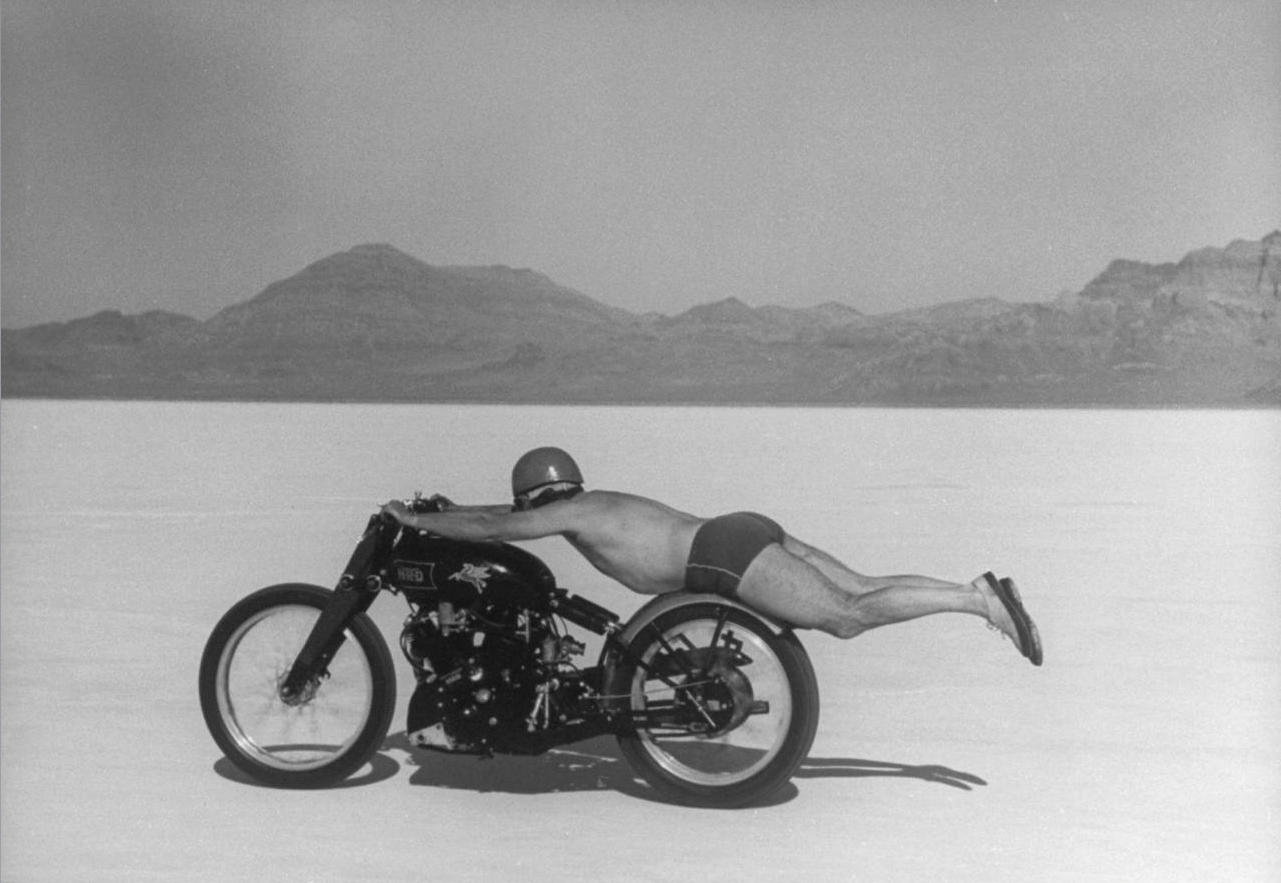
The spotlight the year was "100 years of Speed Trials at the Bonneville Salt Flats".  On hand were a phalanx of custom bikes and stream liners built for the singular purpose of high speed.  Arguably the crown jewel of the display was the 1948 land speed record Rollie Free HRD "Bathing Suit" bike. 

The bike, so named for the scantily clad pilot, is one of the most important bikes of the 20th century, and the "Holy Grail" of Vincent HRD fans.  It was displayed along a wonderful Jeff Decker bronze made to commemorate the September 13, 1948 feat.

Photo capturing the Land Speed Record.  Life Magazine. 

Exquisite Jeff Decker bronze.  


Unfortunately, there were not any historic BMW racing motorcycles on hand for display this year.  While BMW was involved in chasing land speed records, much of the work toward this goal was accomplished prior to World War II, with Hernst Henne piloting Kompressors.  

However, there was a nice cross-section of post war BMW civilian bikes on display.  Some riders, some original survivors and some top notch restorations.  

A nice example of a /2 in "Dover White".  I've heard the term "Bavarian Cream" applied, but cringe every time I hear it!

This tidy plunger frame bike, while not a top notch restoration, is thoroughly enjoyed by the owner and his wife who ride two-up.

Toaster Tank BMW, an apt moniker given the shiny chrome sides of the gas tank.  This bike represents the strong contrast between pre and post 1970 BMWs with drastic design changes coinciding with moving the production of motorcycles from Munich to Berlin.


As Tim Stafford was one of my co-judges in the European Class, his wonderful restoration of an R60//2, pictured below, was presented for display only. 


It's hard to find fault with this bike!  Perhaps the reason it has been so well received at top motorcycle shows.


Monday, January 6, 2014

Motorrad Museum Vorchdorf

In the town of Vorchdorf, Austria, just a short drive from the A1 autobahn which runs between Salzburg and Vienna, lies arguably the best BMW motorcycle collection/museum in the world.

My first visit took place a few years ago, prior to the museum PR campaign, and before there were signs in town leading to the museum.

A friend from Germany knew I was in Austria, and asked if I would like to visit a collection of antique BMW's.  Of course I said yes, and a few days later we met at the autobahn exit for Vorchdorf.

I followed him a few kilometers through town, ending up on a farm with several large, metal buildings.  I later learned these were chicken houses, and the farm produces eggs.

We met up with Franz Amering, the owner of the farm.  As Franz speaks only German, and me English, I let my friend do the talking.  A short time later we followed Franz up a flight of stairs into a modest size room. It was winter time and the building quite cold.

I followed Franz through the door, and my jaw immediately hit the floor.  I instantly began taking pictures of an R51RS, RS54 and prewar race bike, an R63 as I recall.  After drooling over the bikes, and putting my digital camera to task for about 15 minutes, my friend inquired, "You know there are more bikes to see, right?"

In fact I didn't know.  I was pretty excited to see the small collection of rare race bikes.  But I was unprepared for what lay behind the next door.  As I crossed the threshold, it was as if the pearly gates had opened.  (For a moment I saw shining lights and heard angels singing.)

What lay before me was an incredible museum, the work of an industrious egg farmer.  The near entire 90 year history of BMW motorcycles was laid out in a methodical fashion, starting with the R32 and going chronological.

The chronology of the marque is only one guiding factor in the museum layout.  There are also multiple vignettes, including war time machines, police and civil service machines, racing, prototypes, and pre-BMW BMW's.

One of my favorite is the "barn".  An area dedicated to original condition bikes, complete with dirt, cobwebs and I imagine some animal droppings.

The museum has grown and evolved over the years since my first visit. More bikes have been added, and there is now a turn style, and cost for admission.  Still a bargain.

And now, without further adieu, some photos of the Motorrad Museum Vorchdorf.


Cutaway BMW twin from the 1960's.  The museum has quite a number of cutaway motors and bikes.  Most interesting from a technical perspective.


Another cutaway....an R32.  Not sure when this specimen was dissected, but I'm guessing a long time before these bikes started commanding north of 100K.  The museum patron is the lucky beneficiary however.  Where else can you learn the inner workings of BMW's first production motorcycle?


Another wonderful pre-war engine cut-away. 


The above two photos are of a very nice pre-war R16.   The pressed steel frame machines are a wonderful example of art deco influence.   The epitome of which is the uber-rare R7.  Only one R7 exists, and it is in the BMW museum collection in Munich.  The R7 was moth-balled for decades, and only resurfaced in the last few years.  The machine was masterfully reconstructed by a group of craftsmen in Germany. 

Wonderful view of the museum layout, at least part of it.  Accompanying the bikes is plenty of period petroliana, and various BMW marketing and display pieces.  

Nice vignette of pre-war bikes, including Seitenwagen machine.

A very nice R5.  As most BMW aficionados know, the R5 was the hard tail precursor to the R51.  Many consider the R5 to be the ultimate pre-war BMW sport bike.  Certainly its tubular steel frame, and smaller proportions make it a much better handling machine than the Rohr-rahmen or pressed steel frame bikes which preceded it.  This machine is an early example as is evidenced by the lack of air filter on top of the transmission.  Instead, the large "elephant ear" air intakes mount directly to the carburetors.