Total Pageviews

Monday, January 6, 2014

Motorrad Museum Vorchdorf

In the town of Vorchdorf, Austria, just a short drive from the A1 autobahn which runs between Salzburg and Vienna, lies arguably the best BMW motorcycle collection/museum in the world.

My first visit took place a few years ago, prior to the museum PR campaign, and before there were signs in town leading to the museum.

A friend from Germany knew I was in Austria, and asked if I would like to visit a collection of antique BMW's.  Of course I said yes, and a few days later we met at the autobahn exit for Vorchdorf.

I followed him a few kilometers through town, ending up on a farm with several large, metal buildings.  I later learned these were chicken houses, and the farm produces eggs.

We met up with Franz Amering, the owner of the farm.  As Franz speaks only German, and me English, I let my friend do the talking.  A short time later we followed Franz up a flight of stairs into a modest size room. It was winter time and the building quite cold.

I followed Franz through the door, and my jaw immediately hit the floor.  I instantly began taking pictures of an R51RS, RS54 and prewar race bike, an R63 as I recall.  After drooling over the bikes, and putting my digital camera to task for about 15 minutes, my friend inquired, "You know there are more bikes to see, right?"

In fact I didn't know.  I was pretty excited to see the small collection of rare race bikes.  But I was unprepared for what lay behind the next door.  As I crossed the threshold, it was as if the pearly gates had opened.  (For a moment I saw shining lights and heard angels singing.)

What lay before me was an incredible museum, the work of an industrious egg farmer.  The near entire 90 year history of BMW motorcycles was laid out in a methodical fashion, starting with the R32 and going chronological.

The chronology of the marque is only one guiding factor in the museum layout.  There are also multiple vignettes, including war time machines, police and civil service machines, racing, prototypes, and pre-BMW BMW's.

One of my favorite is the "barn".  An area dedicated to original condition bikes, complete with dirt, cobwebs and I imagine some animal droppings.

The museum has grown and evolved over the years since my first visit. More bikes have been added, and there is now a turn style, and cost for admission.  Still a bargain.

And now, without further adieu, some photos of the Motorrad Museum Vorchdorf.


Cutaway BMW twin from the 1960's.  The museum has quite a number of cutaway motors and bikes.  Most interesting from a technical perspective.


Another cutaway....an R32.  Not sure when this specimen was dissected, but I'm guessing a long time before these bikes started commanding north of 100K.  The museum patron is the lucky beneficiary however.  Where else can you learn the inner workings of BMW's first production motorcycle?


Another wonderful pre-war engine cut-away. 


The above two photos are of a very nice pre-war R16.   The pressed steel frame machines are a wonderful example of art deco influence.   The epitome of which is the uber-rare R7.  Only one R7 exists, and it is in the BMW museum collection in Munich.  The R7 was moth-balled for decades, and only resurfaced in the last few years.  The machine was masterfully reconstructed by a group of craftsmen in Germany. 

Wonderful view of the museum layout, at least part of it.  Accompanying the bikes is plenty of period petroliana, and various BMW marketing and display pieces.  

Nice vignette of pre-war bikes, including Seitenwagen machine.

A very nice R5.  As most BMW aficionados know, the R5 was the hard tail precursor to the R51.  Many consider the R5 to be the ultimate pre-war BMW sport bike.  Certainly its tubular steel frame, and smaller proportions make it a much better handling machine than the Rohr-rahmen or pressed steel frame bikes which preceded it.  This machine is an early example as is evidenced by the lack of air filter on top of the transmission.  Instead, the large "elephant ear" air intakes mount directly to the carburetors. 


Friday, December 20, 2013

R51/75 History Now Complete!

The life and history of my 1950 BMW R51/75

Until recently, I only new half of the story of my R51/75.  But through a random twist of fate, and thanks to this very blog, I no longer have to imagine the early history of my motorcycle, I know it in fairly good detail.

My bike started life in Munich.  The project of Hans Bretzner (an Austrian born and German educated car designer) and a Mr. Brenner (race engine mechanic for famed German sidecar champion Walter Schneider).  The project was conceived of and begun in 1948 when Bretzner was only 18 years old.  The bike was ultimately completed in 1950.  It was constructed of new, original spare parts left over from the war.

In attempting to license the bike for road use, a 7 digit serial number was conceived, a combination of Hans's birthdate and his grandmothers house number. This proved problematic with the authorities later on as only 6 digit serial numbers were in use on BMW's at the time.  Ultimately the bike was licensed for street use in Germany and reportedly clocked 124 mph on the autobahn with the open megaphone exhaust.

Some time in the early fifties, Hans immigrated to the United States to work as a designer at GM in Detroit.  He sent for the bike in 1955, prior to which it was gone through at the BMW Works and fitted with full width hubs.

Around 1958, Hans took a job as a designer with Mitsubishi in Tokyo.  Realizing he could not take the bike with him, he reluctantly sold it to Mr. Billie Hummel.  Mr. Hummel and his wife enjoyed riding the powerful bike two up.  He proudly displayed the bike at the Detroit Auto Show, where it was well received.


In the early 60's, the bike was sold by Mr. Hummel to Dutch Becker in California.

Under Becker's stewardship the bike received new valves, specially made from Alfa Romeo racing  valves.  The work reportedly done by Taylor and Ryan Engine Rebuilding in Whittier, CA.

In the 60's, the bike traded hands from Becker to Tom Bell, who owned a gas station in Hollywood on Beverly, near La Brea.  Tom is undoubtedly the "hippie kid" who subsequently sold the bike to Duane Ausherman (some time around 1972).  Duane had run across Tom while at a motorcycle event in Visalia, CA.  Duane, then owner of BMW of Marin in the Bay Area, recognized the bike as something quite special.


One of Duane's mechanics, by the name of Art Pels, campaigned the bike at an AFM sponsored "Run what ya' brung" road race event at the Presidio in San Francisco.


The bike was purchased by Rod Miller, who in the early 1980's undertook a sympathetic restoration.  Work was limited to cosmetics and the motor was never torn down as it was always a strong runner.  Brian Hilton, mechanic for Ozzie Auer in Chico, CA fashioned new fenders for the bike.  Also added was a sportier Lugauer racing tank.

Miller later sold the bike to Bob Garrett of San Francisco.  By this time, the final drive was in need of attention.  Garrett sought out the help of legendary Bay Area machinist and mechanic Joachim Groeger.  Groeger was able to rework to final drive, but perhaps because of lack of interest or money, the bike was sold to Groeger.

It was at Groeger's shop in 2001 that I first laid eyes on the bike.  It was a wonderful machine with a large, powerful 750 motor tucked into the demure plunger frame.  When I came upon the bike, it had suffered from clutch problems. After years of persistence I struck a deal with Joachim to purchase the bike and together we rebuilt the clutch.

Later I reconditioned the top end, putting new piston rings and valves in.


I am indebted to Eric Hummel, son of second owner Billie Hummel for providing me with the photos of the bike from the late 50's and early 60's as well as filling in the information about the original owner, and builder Mr. Bretzner.

Finally, a tremendous thanks to Billie's wife, who was able to dig up the original sales ad from when her husband sold the bike in the early 60's!

Tuesday, June 4, 2013

The starting grid


I wonder if any of these tikes went on to have illustrious racing careers on a BMW?  I love how the kid on the inside is so serious with his tucked position, and intent stare.

Sunday, May 26, 2013

BMW Roundel

The BMW Roundel is one of the most iconic brand images of all time.  The rather simple design, incorporating the company initials, has been the subject of much discussion and speculation over the years.

The Roundel has played prominently in advertising campaigns over the past 90 years, and its origins have been the subject of much discussion among enthusiasts of the marque.

For a well informed article on the history of the logo, refer to BMW Motorcycle Magazine, or this article from the New York Times.

Playing off the theme of incorporating the logo into the spinning blades of an airplane propeller, the folks at BMW recently crafted an impressive display.

BMW is the organizing sponsor of the Concorso d'Eleganza Villa d'Este in Cernobbio, Italy on the shore of Lake Como.  The event is a fantastic gathering of the most important cars and motorcycles, garnered from collections around the world.

Playing off the use of the logo in a 1929 advertisement, seen below, some crafty engineers were able to recreate the effect in real life. Click on the video for a demonstration.


Life imitating art!  The 1929 BMW advertisement comes to life at Villa d'Este.


Just so there is no confusion, the famous checkered white and blue background of the roundel was not originally meant to represent an airplane propeller.  Rather, as anyone who has visisted southern Germany will know, the white and blue colors are from the crest of the Free State of Bavaria. Despite the origins of the company in aircraft engine design, the propeller logo advertisement was not utilized until 1929, well after the roundel was created.  Nonetheless,  the logo was used in graphic design, to fantastic effect.  

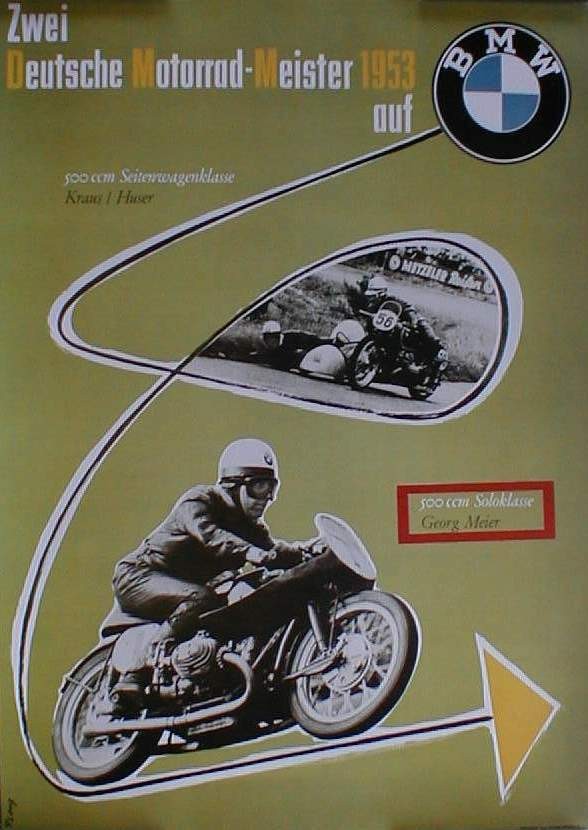
See below for other advertisements prominently showcasing the famous "weiss und blau" roundel!


Wednesday, April 3, 2013

Spezial Kompressor

When Walter Zeller retired from racing for BMW he was given a spectacular gift.  The folks in the racing department had fabricated for him a one-off street legal kompressor.  The motor was a pre-war sidecar lump.   It was fitted to a custom tubular steel frame very similar to the RS54.  Of course the requisite headlight and taillight were included.  The story goes that Walter enjoyed the bike for several years before selling it to a school teacher who had lusted after the bike for quite some time.  After the death of the school teacher, the bike changed hands under questionnable circumstances.  It was recently sold to a dealer/collector in Germany. 

Much to my surprise, and delight, the bike was on display at the recent Veterama held at Hockenheim.  See below for some pictures.