Total Pageviews

Sunday, May 26, 2013

BMW Roundel

The BMW Roundel is one of the most iconic brand images of all time.  The rather simple design, incorporating the company initials, has been the subject of much discussion and speculation over the years.

The Roundel has played prominently in advertising campaigns over the past 90 years, and its origins have been the subject of much discussion among enthusiasts of the marque.

For a well informed article on the history of the logo, refer to BMW Motorcycle Magazine, or this article from the New York Times.

Playing off the theme of incorporating the logo into the spinning blades of an airplane propeller, the folks at BMW recently crafted an impressive display.

BMW is the organizing sponsor of the Concorso d'Eleganza Villa d'Este in Cernobbio, Italy on the shore of Lake Como.  The event is a fantastic gathering of the most important cars and motorcycles, garnered from collections around the world.

Playing off the use of the logo in a 1929 advertisement, seen below, some crafty engineers were able to recreate the effect in real life. Click on the video for a demonstration.


Life imitating art!  The 1929 BMW advertisement comes to life at Villa d'Este.


Just so there is no confusion, the famous checkered white and blue background of the roundel was not originally meant to represent an airplane propeller.  Rather, as anyone who has visisted southern Germany will know, the white and blue colors are from the crest of the Free State of Bavaria. Despite the origins of the company in aircraft engine design, the propeller logo advertisement was not utilized until 1929, well after the roundel was created.  Nonetheless,  the logo was used in graphic design, to fantastic effect.  

See below for other advertisements prominently showcasing the famous "weiss und blau" roundel!




Wednesday, April 3, 2013

Spezial Kompressor

When Walter Zeller retired from racing for BMW he was given a spectacular gift.  The folks in the racing department had fabricated for him a one-off street legal kompressor.  The motor was a pre-war sidecar lump.   It was fitted to a custom tubular steel frame very similar to the RS54.  Of course the requisite headlight and taillight were included.  The story goes that Walter enjoyed the bike for several years before selling it to a school teacher who had lusted after the bike for quite some time.  After the death of the school teacher, the bike changed hands under questionnable circumstances.  It was recently sold to a dealer/collector in Germany. 

Much to my surprise, and delight, the bike was on display at the recent Veterama held at Hockenheim.  See below for some pictures.


Sunday, March 31, 2013

BMW Welt


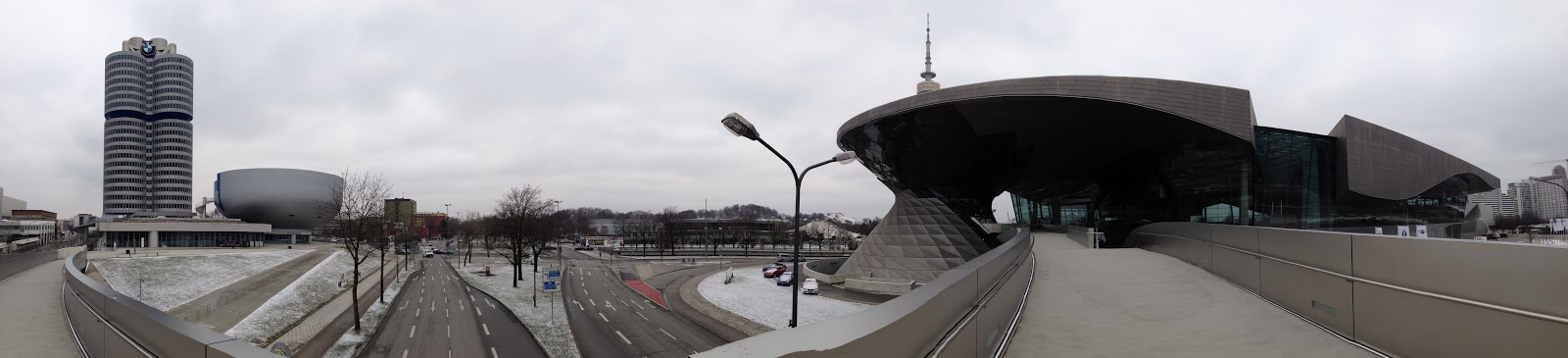
"Trick Shot" I used the panorama function on my iPhone to create this photo of BMW Welt and the Museum complex.  The buildings are actually across the street from each other.

A few years ago BMW undertook a massive project in Munich.  In addition to updating the aging BMW museum, they constructed an architectural masterpiece called BMW Welt.  A skybridge over the road connects the futuristic appearing BMW Welt structure to the iconic BMW towers and museum complex.  BMW Welt serves many functions: delivery center for owners of newly purchased BMW's, showcase for display of BMW's lineup of cars and motorcycles, showcase of BMW's boutique brands such as Mini and Rolls Royce, technology display, etc.  In addition, there a very nice restaurant and facilities for corporate events.

Across the street, the musuem appears as a round building, a bit reminiscent of the Guggenheim museum in New York.  Indeed once inside there is a spiral ramp leading visitors to the top of an impressive display.  However, this is only the tip of the proverbial iceberg.  A massive new museum complex lies partially below grade and offers visitors hours of enjoyment pouring over the impressive history of BMW, including the productions of cars, trains, motorcycles, airplane engines and jet engines.

Of course like most museums, there is a shop which sells all manner of BMW paraphernalia including an impressive number of books.  "Lifestyle" items such as clothing, toys, etc can be purchased at the BMW Welt complex.


The iconic towers of BMW.  The complex lies just north of the Olympia Park, former site of the Munich Olympics.

The museum is quite a bit larger than one might expect from looking at this photo as a great deal of it is below grade.


Inside BMW Welt


Restaurant, above which lies facilities for corporate entertaining.


The shear size of BMW Welt is difficult to capture with photos.


The original BMW Motorrad, the R32.  It is fairly well known that BMW supplied motors to various motorcycle manufacturers prior to 1923, however, the R32 represents the first all BMW production motorcycle.

"Teile in Eile" = Parts in a hurry!

My two favorite vintage BMW cars of all time, the iconic 328 and the sporty 507. 


Pre-war vertical shaft "Kompressor".  This bike was made famous by Georg "Schorsch" Meier in 1939 when he won the famous Isle of Man TT.  It was the last before World War 2, and the end of an era as the FIM subsequently banned supercharging.


Another iconic and rare pre-war race bike, the R51RS.  Similar to the road going R51 at first glance, closer inspection reveals a staggering number of differences.  Less  than 20 were made originally, and intended for accomplished privateer racers around the world.

A brief list of some differences between the R51 and R51RS include the extensive use of Elektron, a light weight magnesium alloy.  Absence of road going devices such as lights, horn, mirrors, etc.  Aluminum instead of steel fenders.  Larger carburetors.  Special cast cylinders, racing gearset in transmission, larger wheels front and rear.  Magneto ignition instead of battery/coil. Timing gears instead of timing chain.  And the list goes on...

View of the R51RS motor including the magnesium housed magneto, and the transmission support bracket that doubles as a "Kurzenhalter".


Also part of the racing display is a Rennsport in "256" Works trim.  Some of the differences from the original RS54 include a short stroke motor, larger double front brake, fairing, hydraulic brake on the rear and a rear torsion bar or "drehmoment".  The carbs are Dell'Orto and the tachometer a Smith's ATRC. 


The bike is rumored to be one that Walter Zeller campaigned.  However as far as I know most of the works bikes didn't have serial numbers per se.  And there was never any documentation about which specific bikes were campaigned at specific events.  Everyone who owns a Rennsport likes to believe that it was once owned or raced by Walter Zeller, and BMW is no different!


Friday, December 28, 2012

R51/75 Racebike

Some time ago I posted some pictures and info about the curious post-war BMW's sometimes refered to as R51/75.  These are plunger frame chassis fitted with a war-time 750 cc motor.  Most often these are seen with a sidecar attached, but solo forms exist.

I have in my collection such a bike, built in Germany in 1950.  It somehow found its way to the states, though the circumstances remain a mystery.   The history of my bike is known back to 1972 when a friend and former BMW dealer owned it.  There have been five owners since.  Below are some pictures of the bike over the years.

The R51/75 circa 1972 as seen from the left. (Photos from Duane Ausherman)

The R51/75 circa 1972 as seen from the right.
 

Art Pels astride the R51/75 at an AMF race at the Presidio (San Francisco) 1972. (Photo courtesy of Art Pels)

The bike as it exists today.  The rear fender was changed to a racing style, courtesy of Brian Hilton in the early 1980's.  The sidecar style Amal Fischer carbs have been exchanged for Dell'Orto's.  An R5 transmission case has been utilized.  (The original racing gear set was transferred from the old housing.)

Update!

I was recently contacted by the son of a former owner of my motorcycle who has shared some interesting history and photos.  I am awaiting more details, but will attach one of the photos that has been shared with me.

The bike as it appeared in August of 1960.  It was registered in Michigan and being ridden by a Mr. Hummel and his wife.
 

Nearly identical bike, with sidecar, being raced in Ingolstadt, Germany 1952.  Notice the drilled hubs.


Sunday, November 18, 2012

Post-war plunger toolkit

A fellow collector was recently asking for pictures of an original, post-war plunger frame bike toolkit.  Attached below are photos of an original kit that came with my 1952 R68.  The same would have been supplied with R51/3 and R67.


The bag is a canvas material and sort of grey-green in color.


Wrench size ranges from SW 6.5 to SW 41.  Notice what wrench size is absent?  No 13 mm.  The reason being in 1952 the DIN for an M8 was still SW 14 for the nut and bolt. 


The wrenches are marked "Walter".  The logo is similar to the Volkswagen logo, only with two crossed hammers forming the "W".  The large wrench is a "Hazet" and the small carb wrench is not marked. 


The pliers are marked "Rahsol" and the pin wrench has a BMW "Zeichnungsnummer" or drawing number.


For those not familiar with the older BMW numbering system, the above number isn't a part number, and its not a casting number.  It is a drawing number, with some logic to it.  251.3 is the frame type, that corresponds to R51/3 and R67.  The number 97 refers to the "group".  In the old BMW system, group 97 is "tools".  The 017 is the number of a specific tool, in this case 017 is the pin wrench.  Finally 04 corresponds to the size of the drawing, in this case 04 means that the drawing was A4 paper size.